SciNatured

SciNaturedSciNaturedSciNatured
Home
About Us
Start Here
Downloads
Members Only
Join The Club
January22

SciNatured

SciNaturedSciNaturedSciNatured
Home
About Us
Start Here
Downloads
Members Only
Join The Club
January22
More
  • Home
  • About Us
  • Start Here
  • Downloads
  • Members Only
  • Join The Club
  • January22
  • Sign In
  • Create Account

  • Orders
  • My Account
  • Signed in as:

  • filler@godaddy.com


  • Orders
  • My Account
  • Sign out

Signed in as:

filler@godaddy.com
  • Home
  • About Us
  • Start Here
  • Downloads
  • Members Only
  • Join The Club
  • January22

Account

  • Orders
  • My Account
  • Sign out

  • Sign In
  • Orders
  • My Account

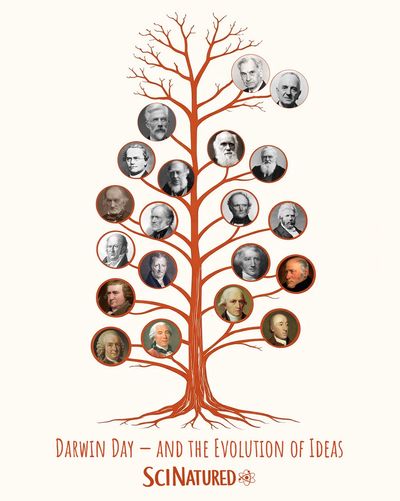
🧬 Darwin Day — and the Evolution of Ideas

Today is Darwin Day — a day honoring Charles Darwin, often called the father of evolution.

But like evolution itself, scientific understanding does not appear in a single leap.
It grows gradually. It builds on earlier forms. It adapts. It refines.

Just as species evolve over time, knowledge evolves too.

Darwin’s theory of natural selection was revolutionary — but it was not created in isolation. It was part of a much longer intellectual journey shaped by many thinkers before him and alongside him.


🌱 These scientists helped lay the groundwork for evolutionary thought:


  • Erasmus Darwin (1731–1802)
    Early ideas about species change and common ancestry.
    https://en.wikipedia.org/wiki/Erasmus_Darwin
     
  • Jean-Baptiste Lamarck (1744–1829)
    One of the first to propose a formal theory of evolution.
    https://en.wikipedia.org/wiki/Jean-Baptiste_Lamarck
     
  • Georges-Louis Leclerc, Comte de Buffon (1707–1788)
    Suggested that species might change over time.
    https://en.wikipedia.org/wiki/Georges-Louis_Leclerc,_Comte_de_Buffon
     
  • Étienne Geoffroy Saint-Hilaire (1772–1844)
    Proposed structural unity among animals.
    https://en.wikipedia.org/wiki/%C3%89tienne_Geoffroy_Saint-Hilaire
     
  • Georges Cuvier (1769–1832)
    Founder of paleontology; demonstrated extinction.
    https://en.wikipedia.org/wiki/Georges_Cuvier
     
  • James Hutton (1726–1797)
    Introduced the concept of “deep time.”
    https://en.wikipedia.org/wiki/James_Hutton
     
  • Charles Lyell (1797–1875)
    Developed uniformitarian geology — crucial for Darwin’s thinking.
    https://en.wikipedia.org/wiki/Charles_Lyell
     
  • William Smith (1769–1839)
    Pioneer of stratigraphy and fossil succession.
    https://en.wikipedia.org/wiki/William_Smith_(geologist)
     
  • Carl Linnaeus (1707–1778)
    Created the modern classification system.
    https://en.wikipedia.org/wiki/Carl_Linnaeus
     
  • Thomas Robert Malthus (1766–1834)
    His work on population pressure influenced Darwin’s idea of natural selection.
    https://en.wikipedia.org/wiki/Thomas_Robert_Malthus
     
  • Robert Chambers (1802–1871)
    Published Vestiges of the Natural History of Creation (1844), preparing public debate on evolution.
    https://en.wikipedia.org/wiki/Robert_Chambers_(publisher,_born_1802)
     

🌿 Darwin was not alone in his century.


  • Alfred Russel Wallace (1823–1913)
    Independently conceived natural selection; their findings were presented jointly in 1858.
    https://en.wikipedia.org/wiki/Alfred_Russel_Wallace
     
  • Joseph Dalton Hooker (1817–1911)
    Botanist and close collaborator of Darwin.
    https://en.wikipedia.org/wiki/Joseph_Dalton_Hooker
     
  • Richard Owen (1804–1892)
    Developed the concept of homology in comparative anatomy.
    https://en.wikipedia.org/wiki/Richard_Owen
     
  • Gregor Mendel (1822–1884)
    Discovered the laws of inheritance — later essential to evolutionary biology.
    https://en.wikipedia.org/wiki/Gregor_Mendel
     

🧬 Three scientists were especially influential in shaping modern evolutionary theory:


Darwin explained how natural selection works.
The 20th century explained how inheritance makes it possible.


  • Ronald Aylmer Fisher (1890–1962)
    One of the founders of population genetics.
    In 1918 he mathematically reconciled Mendelian inheritance with natural selection, and in The Genetical Theory of Natural Selection (1930) he gave evolution a rigorous statistical foundation.
    https://en.wikipedia.org/wiki/Ronald_Fisher
     
  • Theodosius Dobzhansky (1900–1975)
    A central architect of the Modern Synthesis.
    His book Genetics and the Origin of Species (1937) demonstrated that evolution could be observed and measured in real populations.
    https://en.wikipedia.org/wiki/Theodosius_Dobzhansky
     
  • Ernst Mayr (1904–2005)
    Developed the biological species concept and clarified mechanisms of speciation.
    His work integrated systematics, geography, and evolutionary theory into a unified framework.
    https://en.wikipedia.org/wiki/Ernst_Mayr
     

Together, they transformed Darwin’s 19th-century insight into the comprehensive evolutionary biology we recognize today.


🌍 Darwin Day is not only about one brilliant scientist.

It is about the long, collective journey of human curiosity.

Just as species evolve through countless generations,
ideas evolve through countless minds.

Science is not a monument.
It is a living process.


Darwin didn’t work alone — he connected centuries of curiosity into a powerful framework in On the Origin of Species (1859).

And evolution — both biological and intellectual — continues today.


And that may be the most evolutionary idea of all.

Join the Club Today

✨ Join the SciNatured Club. Subscribe to unlock member-only printables, creative activities, and learning adventures.

Copyright © 2025 SciNatured - All Rights Reserved.

  • About Us
  • Start Here
  • Downloads
  • Story Time
  • FAQ
  • Members Only
  • Contact Us
  • Join The Club
  • Birds of Ontario
  • Calendar

This website uses cookies.

We use cookies to analyze website traffic and optimize your website experience. By accepting our use of cookies, your data will be aggregated with all other user data.

Accept